
Blog5 MIN READ

While Oklo’s engineers worked around the clock to bring the Groves-1 Isotope Test Reactor to criticality, another important piece of Oklo Isotopes’ business arrived: two grams of enriched ytterbium-176.
It may not sound like much. Weighing less than a penny, this tiny amount of material represents something much bigger: another step toward building a domestic supply chain for isotopes that can support critical medical treatments.
Ytterbium-176 is the first stable isotope to be added to Oklo’s inventory.
It arrived just days before starting up Groves 1, the reactor that provides an operational foundation for our isotope business. Together, the two milestones demonstrated the pieces we’re bringing together: securing the raw materials while developing the irradiation capabilities needed to transform them into high-value isotopes. Proving out these supply chain elements was the point of the Reactor Pilot Program.
For isotopes, the irradiation target feedstock is just as important as the steam generator or as the turbine is for a nuclear power facility.
When irradiated in a reactor just like Groves, it first becomes ytterbium-177, then rapidly decays into lutetium-177. Lutetium-177 is essential to attach to tumor-targeting cancer therapies such as FDA-approved Pluvicto for prostate cancer and Lutathera for neuroendocrine tumors.
Yet, the global supply of ytterbium-176 has historically depended heavily on Russia and remains concentrated among relatively few suppliers, leaving patients and healthcare providers reliant on a fragile supply chain for a critical material. At nuclear medicine conferences, an uncanny number of companies all tell me that they, “have access to 200 grams of ytterbium!” Yet, with a little digging, it’s all the same material from the same low-quality Russian stockpile. Working with domestic companies like Actinide Inc. is our opportunity to change that.

Receiving this material at the site of the fastest-built reactor project of its kind is a major milestone in its own right. When I first met the Actinide folks late last year, their first calutron was still a collection of parts awaiting transport to their new workspace. Within months of moving, they had their machine assembled and tuned, creating highly-enriched ytterbium in just the first pass.
The reception of ytterbium-176 at Groves is what supply chain development looks like in practice: securing feedstock, building the infrastructure needed to transform it, and developing the capabilities to deliver the finished product. Oklo’s business model aims to bring the many aspects of modern advanced nuclear, including clean, reliable power, recycled used nuclear fuel, and isotope production, under one roof.
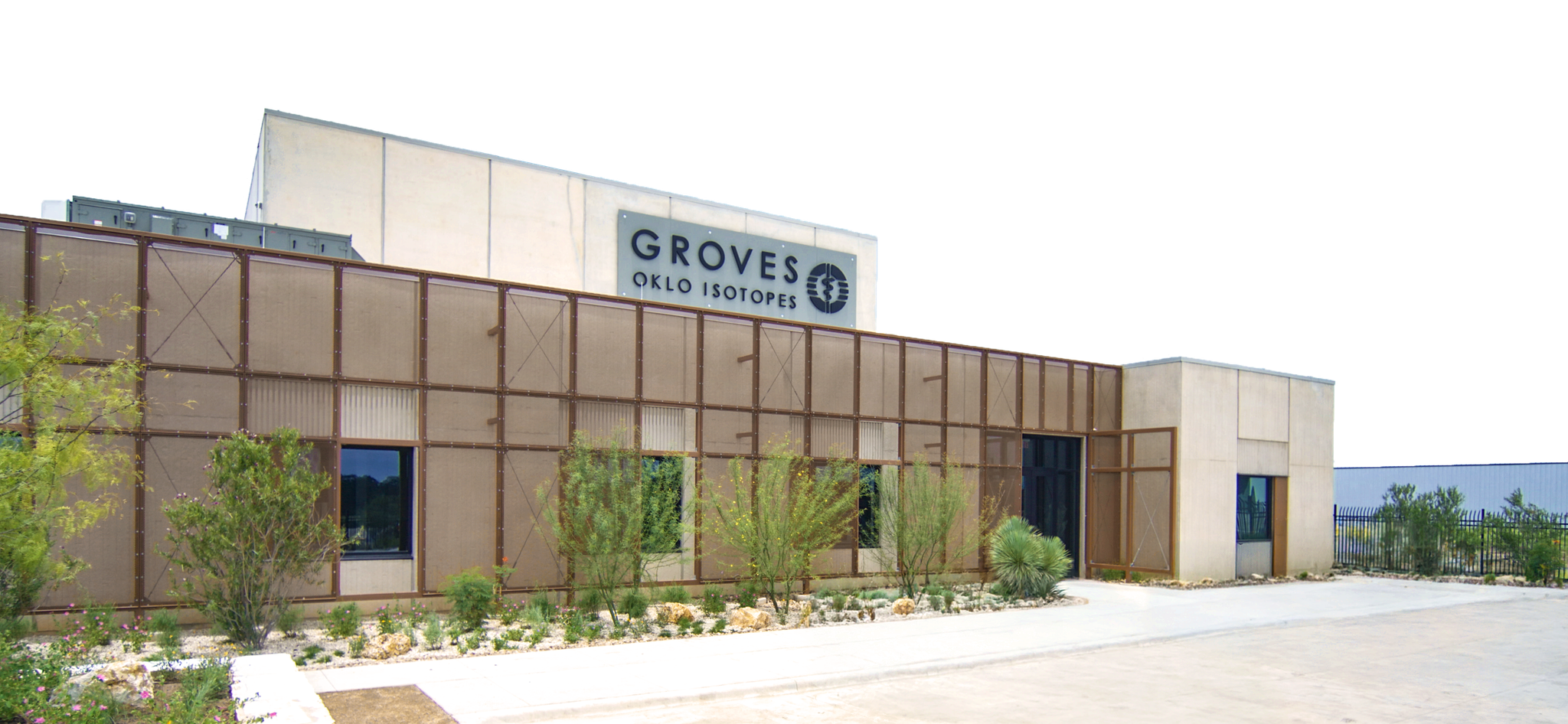
Our team brought the Groves reactor in Lockhart, Texas from greenfield to first criticality in less than a year, on private land, and using in-house manufactured or commercially procured components and fuel. Rebuilding America’s isotope supply requires the ability to build, start up, and operate new nuclear facilities needed to put that material to use. But it also requires working with partners that share our vision and who work to accomplish seemingly impossible things in a seemingly impossible timeline.
This small vial of powder carries enormous potential as the feedstock for thousands of doses of cancer treatment.
At Oklo Isotopes, we are realizing that potential on a timescale measured in months rather than years.
(Also, the Criticality Beard is proof of material receipt prior to criticality!)